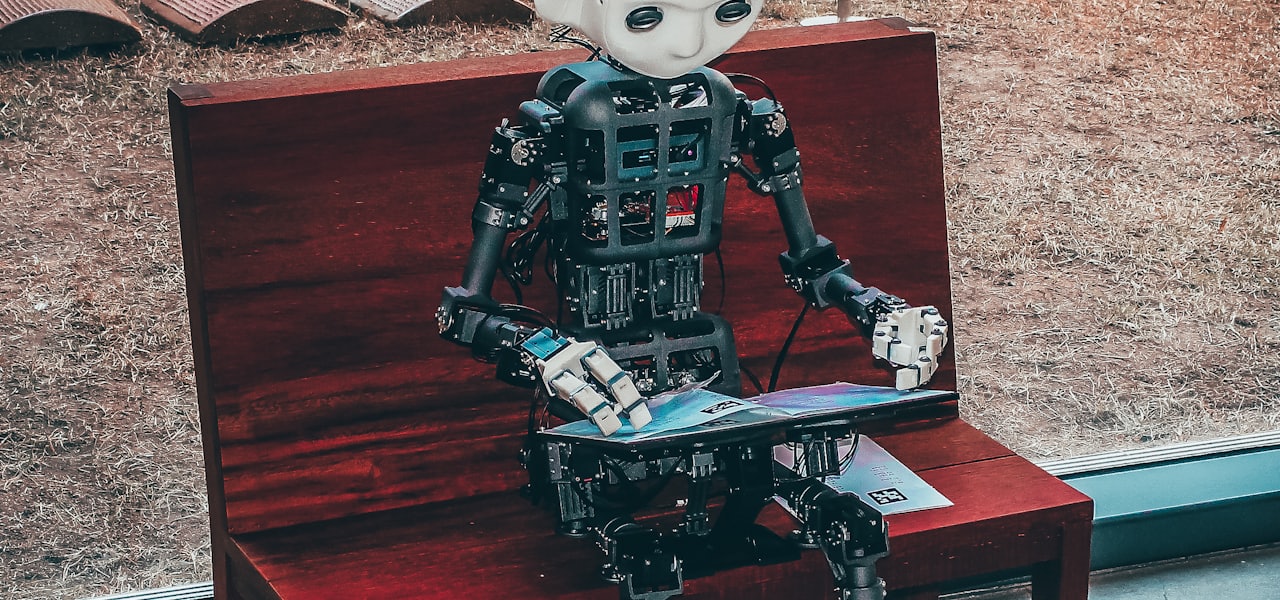
Developmental robotics (DevRob), sometimes called epigenetic robotics, is a scientific field which aims at studying the developmental mechanisms, architectures and constraints that allow lifelong and open-ended learning of new skills and new knowledge in embodied machines. As in human children, learning is expected to be cumulative and of progressively increasing complexity, and to result from self-exploration of the world in combination with social interaction. The typical methodological approach consists in starting from theories of human and animal development elaborated in fields such as developmental psychology, neuroscience, developmental and evolutionary biology, and linguistics, then to formalize and implement them in robots, sometimes exploring extensions or variants of them. The experimentation of those models in robots allows researchers to confront them with reality, and as a consequence, developmental robotics also provides feedback and novel hypotheses on theories of human and animal development. Developmental robotics is related to but differs from evolutionary robotics (ER). ER uses populations of robots that evolve over time, whereas DevRob is interested in how the organization of a single robot's control system develops through experience, over time. DevRob is also related to work done in the domains of robotics and artificial life. == Background == Can a robot learn like a child? Can it learn a variety of new skills and new knowledge unspecified at design time and in a partially unknown and changing environment? How can it discover its body and its relationships with the physical and social environment? How can its cognitive capacities continuously develop without the intervention of an engineer once it is "out of the factory"? What can it learn through natural social interactions with humans? These are the questions at the center of developmental robotics. Alan Turing, as well as a number of other pioneers of cybernetics, already formulated those questions and the general approach in 1950, but it is only since the end of the 20th century that they began to be investigated systematically. Because the concept of adaptive intelligent machines is central to developmental robotics, it has relationships with fields such as artificial intelligence, machine learning, cognitive robotics or computational neuroscience. Yet, while it may reuse some of the techniques elaborated in these fields, it differs from them from many perspectives. It differs from classical artificial intelligence because it does not assume the capability of advanced symbolic reasoning and focuses on embodied and situated sensorimotor and social skills rather than on abstract symbolic problems. It differs from cognitive robotics because it focuses on the processes that allow the formation of cognitive capabilities rather than these capabilities themselves. It differs from computational neuroscience because it focuses on functional modeling of integrated architectures of development and learning. More generally, developmental robotics is uniquely characterized by the following three features: It targets task-independent architectures and learning mechanisms, i.e. the machine/robot has to be able to learn new tasks that are unknown by the engineer; It emphasizes open-ended development and lifelong learning, i.e. the capacity of an organism to acquire continuously novel skills. This should not be understood as a capacity for learning "anything" or even “everything”, but just that the set of skills that is acquired can be infinitely extended at least in some (not all) directions; The complexity of acquired knowledge and skills shall increase (and the increase be controlled) progressively. Developmental robotics emerged at the crossroads of several research communities including embodied artificial intelligence, enactive and dynamical systems cognitive science, connectionism. Starting from the essential idea that learning and development happen as the self-organized result of the dynamical interactions among brains, bodies and their physical and social environment, and trying to understand how this self-organization can be harnessed to provide task-independent lifelong learning of skills of increasing complexity, developmental robotics strongly interacts with fields such as developmental psychology, developmental and cognitive neuroscience, developmental biology (embryology), evolutionary biology, and cognitive linguistics. As many of the theories coming from these sciences are verbal and/or descriptive, this implies a crucial formalization and computational modeling activity in developmental robotics. These computational models are then not only used as ways to explore how to build more versatile and adaptive machines but also as a way to evaluate their coherence and possibly explore alternative explanations for understanding biological development. == Research directions == === Skill domains === Due to the general approach and methodology, developmental robotics projects typically focus on having robots develop the same types of skills as human infants. A first category that is important being investigated is the acquisition of sensorimotor skills. These include the discovery of one's own body, including its structure and dynamics such as hand-eye coordination, locomotion, and interaction with objects as well as tool use, with a particular focus on the discovery and learning of affordances. A second category of skills targeted by developmental robots are social and linguistic skills: the acquisition of simple social behavioural games such as turn-taking, coordinated interaction, lexicons, syntax and grammar, and the grounding of these linguistic skills into sensorimotor skills (sometimes referred as symbol grounding). In parallel, the acquisition of associated cognitive skills are being investigated such as the emergence of the self/non-self distinction, the development of attentional capabilities, of categorization systems and higher-level representations of affordances or social constructs, of the emergence of values, empathy, or theories of mind. === Mechanisms and constraints === The sensorimotor and social spaces in which humans and robot live are so large and complex that only a small part of potentially learnable skills can actually be explored and learnt within a life-time. Thus, mechanisms and constraints are necessary to guide developmental organisms in their development and control of the growth of complexity. There are several important families of these guiding mechanisms and constraints which are studied in developmental robotics, all inspired by human development: Motivational systems, generating internal reward signals that drive exploration and learning, which can be of two main types: extrinsic motivations push robots/organisms to maintain basic specific internal properties such as food and water level, physical integrity, or light (e.g. in phototropic systems); intrinsic motivations push robot to search for novelty, challenge, compression or learning progress per se, thus generating what is sometimes called curiosity-driven learning and exploration, or alternatively active learning and exploration; Social guidance: as humans learn a lot by interacting with their peers, developmental robotics investigates mechanisms that can allow robots to participate to human-like social interaction. By perceiving and interpreting social cues, this may allow robots both to learn from humans (through diverse means such as imitation, emulation, stimulus enhancement, demonstration, etc. ...) and to trigger natural human pedagogy. Thus, social acceptance of developmental robots is also investigated; Statistical inference biases and cumulative knowledge/skill reuse: biases characterizing both representations/encodings and inference mechanisms can typically allow considerable improvement of the efficiency of learning and are thus studied. Related to this, mechanisms allowing to infer new knowledge and acquire new skills by reusing previously learnt structures is also an essential field of study; The properties of embodiment, including geometry, materials, or innate motor primitives/synergies often encoded as dynamical systems, can considerably simplify the acquisition of sensorimotor or social skills, and is sometimes referred as morphological computation. The interaction of these constraints with other constraints is an important axis of investigation; Maturational constraints: In human infants, both the body and the neural system grow progressively, rather than being full-fledged already at birth. This implies, for example, that new degrees of freedom, as well as increases of the volume and resolution of available sensorimotor signals, may appear as learning and development unfold. Transposing these mechanisms in developmental robots, and understanding how it may hinder or on the contrary ease the acquisition of novel complex skills is a central questi
Principle of rationality
The principle of rationality (or rationality principle) was coined by Karl R. Popper in his Harvard Lecture of 1963, and published in his book Myth of Framework. It is related to what he called the 'logic of the situation' in an Economica article of 1944/1945, published later in his book The Poverty of Historicism. According to Popper's rationality principle, agents act in the most adequate way according to the objective situation. It is an idealized conception of human behavior which he used to drive his model of situational analysis. Cognitive scientist Allen Newell elaborated on the principle in his account of knowledge level modeling. == Popper == Popper called for social science to be grounded in what he called situational analysis or situational logic. This requires building models of social situations which include individual actors and their relationship to social institutions, e.g. markets, legal codes, bureaucracies, etc. These models attribute certain aims and information to the actors. This forms the 'logic of the situation', the result of reconstructing meticulously all circumstances of an historical event. The 'principle of rationality' is the assumption that people are instrumental in trying to reach their goals, and this is what drives the model. Popper believed that this model could be continuously refined to approach the objective truth. Popper called his principle of rationality nearly empty (a technical term meaning without empirical content) and strictly speaking false, but nonetheless tremendously useful. These remarks earned him a lot of criticism because seemingly he had swerved from his famous Logic of Scientific Discovery. Among the many philosophers having discussed Popper's principle of rationality from the 1960s up to now are Noretta Koertge, R. Nadeau, Viktor J. Vanberg, Hans Albert, E. Matzner, Ian C. Jarvie, Mark A. Notturno, John Wettersten, Ian C. Böhm. == Newell == In the context of knowledge-based systems, Newell (in 1982) proposed the following principle of rationality: "If an agent has knowledge that one of its actions will lead to one of its goals, then the agent will select that action." This principle is employed by agents at the knowledge level to move closer to a desired goal. An important philosophical difference between Newell and Popper is that Newell argued that the knowledge level is real in the sense that it exists in nature and is not made up. This allowed Newell to treat the rationality principle as a way of understanding nature and avoid the problems Popper ran into by treating knowledge as non physical and therefore non empirical.
Virtual advertising
Virtual advertising is the use of digital technology to insert virtual advertisements into a live or pre-recorded television show, often in sports events. This technique is often used to allow broadcasters to overlay existing physical advertising panels inside the sports venue with virtual content on the screen when broadcasting the same event in multiple regions; a Spanish football game can be broadcast in Mexico with Mexican advertisements. Similarly, virtual content can be inserted onto empty space within the sports venue such as the pitch, where physical advertising cannot be placed due to regulatory or safety reasons. Virtual advertising content is intended to be photorealistic, so that the viewer has the impression they are seeing the real in-stadium advertising. == History == Throughout the 1980s, 1990s, and 2000s, advertising on television and in newspapers was a popular method of spreading information. The marketer Jeremiah Lynwood stated that "Thirty years ago, [U.S.] consumers viewed an average of 560 ads per day", mostly from newspapers, television shows, gasoline pumps, and so on. Lynwood also stated that, at the time, "American consumers may be exposed to 3,000 commercial messages every day". Within that time frame, the exposure of daily ads have supported many local and big businesses. With the arrival of the 2000s and 2010s, technological advances have created new opportunities for many businesses to grow. In the 21st century, virtual advertising has been used to create virtual product placements in television shows hours, days, or years after they have been produced. Advertisements can be targeted to regional markets and updated over time to ensure maximum efficiency of advertising money. A good example of how virtual advertising is used in everyday life is in sports. Virtual advertising uses the latest technology to place an ad in position to the field of play, regardless of camera motion, and the players' movement over the logos. Recently, the NHL have virtually inserted sponsors on the glass above the physical boards in NHL stadiums. Big brands will not spend their time or money on hitting a certain region when their main goal is to build global brand awareness. Digital signage opportunities allow these larger brands to purchase signage in a stadium during games that are instead nationally televised. This gets even more expansive thanks to social media outlets like Twitter, Facebook, and Amazon. On the other hand, local businesses sign when there are smaller games going on. The signage is much more affordable and still reaches a vast number of people. Virtual advertising may even make live attendance more attractive to sport fans because the technology allows the playing field and surrounding areas to be cleared of advertisements while television viewers at home are exposed to commercials. For the most part, virtual advertising makes a live attendance more attractive to sports fans, because instead of being at home watching commercials, live fans are able to be clear of advertisements and enjoy the game without pop-up ads. == Technology == The technology used in virtual insertions often uses automated processes such as: automatic detection of playfield limits, automatic detection of cuts, recognition of playfield surface, recognition of existing logos for logo replacements, etc. An operator is usually dedicated to the visual control of the effect but new systems allow to use the instant replay operator. == Examples == === Live events === Virtual advertisements can be effectively integrated into live television in real-time. For example, Fox Sports Net places a virtual advertisement on the glass behind the goaltender that can only be seen on television. The advertising in the playfields is property of the club, except in some professional sports where the league or federation owns the advertising rights. However, the advertising rights broadcast on the screen are property of the broadcasters or the TV channel. This means that second right holders can benefit from selling this virtual advertising. The number of TV viewers is also higher than the people in the stadium, generating more visibility to the advertised marks and more income to the broadcasters. Virtual advertising was first introduced in football during the 2015 Audi Cup at the Allianz Arena in Munich. AIM Sport implemented the technology to digitally overlay advertisements on the stadium's perimeter boards, allowing different sponsors to be displayed to viewers in different broadcast regions. In Formula One, virtual ads are placed on the grass or as virtual billboards. In baseball, Major League Baseball places virtual advertisements on a back-board behind the batter which can be targeted differently in local markets or countries. During the World Series, MLB international broadcasts of the World Series feature different advertisements on a per market basis, showing a different ad in the US, Canadian, Latin American and Japanese markets. In tennis, e.g. during the 2019 ATP Finals in London's O2 Arena certain logos in the background were replaced for various country feeds. In table tennis e.g. during the ITTF World Tour Australian Open 2019 virtual advertising overlays were used by uniqFEED AG in Switzerland. Since the 2022–23 season, the National Hockey League (NHL) has used digitally enhanced dasherboards (DED) to erase and replace ads on each arena's boards with up to 120 thirty-second segments on all or part of the rink. Each broadcaster can use a different set of ads. DED were first used at the 2016 World Cup of Hockey, which was organized by the NHL. At UEFA Euro 2024, AIM Sport provided virtual advertising for all matches, marking one of the largest implementations of the technology in an international tournament. In addition to the tournament itself, virtual advertising was also used in the participating teams' domestic matches, extending region-specific advertising beyond the competition itself.
DiscoVision
DiscoVision is the name of several things related to the video LaserDisc format. It was the original name of the "Reflective Optical Videodisc System" format later known as "LaserVision" or LaserDisc. == Description == MCA DiscoVision, Inc. was a division of entertainment giant MCA (Music Corporation of America), established in 1969 to develop and sell an optical videodisc system. MCA released discs pressed in Carson and Costa Mesa, California on the DiscoVision label from the format's Atlanta, Georgia launch in 1978 to 1982 and the release of the film The Four Seasons. DiscoVision titles included films from Universal Pictures, Paramount Pictures, Warner Bros. Pictures, and Disney content. Agreements were made with Columbia Pictures and United Artists, though no discs were released on the DiscoVision label from either studio. Most of these companies later established their own labels for the format, the first being Paramount with a dozen movies released on the Paramount Home Video label in the summer of 1981. The successor to MCA DiscoVision, DiscoVision Associates (DVA), was the result of a partnership between IBM and MCA. It was hoped that the merger would provide the basis for improvement of the quality of DiscoVision pressings, but no appreciable improvement ever took hold. In 1981, responsibility for the laser videodisc was sold to Pioneer Electronic Corporation, after MCA Discovision had previously started a partnership in 1977 with Pioneer, Universal Pioneer, to produce the Pioneer PR-7820 player (the first industrial model of DiscoVision player from 1978), as well as establishing disc pressing plants in Japan. As part of the partnership, Pioneer, in association with MCA, had a disc replication facility in Kofu, Japan that produced discs. Some of the last DiscoVision label discs were manufactured by Pioneer in Japan. In the same year, MCA discontinued their DiscoVision branding, due to the sale of the technology to Pioneer (who then rebranded the format as LaserDisc) and in turn rebranded their laserdisc releases, now fabricated by Pioneer, under the MCA Videodisc banner; this was changed to the "MCA Home Video" name for both its VHS and videodisc releases. Some of DiscoVision's technical staff went on to form MCA Video Games, in an effort to produce video game cartridges. DiscoVision Associates later evolved into a patent holding company which manages and licenses intellectual property related to LaserDisc, Compact Disc, and optical disc technologies, as well as other non-disc related fields. In 1989, Pioneer acquired DiscoVision Associates where it continues to license its technologies independently. As the portfolio of patent expired, the presence of DiscoVision became less visible. However, it established the success of a patent holding company, which other companies are stimulated to generate royalty income from their own patent portfolio.
Nuclear electronics
Nuclear electronics is a subfield of electronics concerned with the design and use of high-speed electronic systems for nuclear physics and elementary particle physics research, and for industrial and medical use. Essential elements of such systems include fast detectors for charged particles, discriminators for separating them by energy, counters for counting the pulses produced by individual particles, fast logic circuits (including coincidence and veto gates), for identification of particular types of complex particle events, and pulse height analyzers (PHAs) for sorting and counting gamma rays or particle interactions by energy, for spectral analysis. == Elementary components == Some of the essential components that make up the elements of a nuclear electronic analysis system include: Detectors Bias voltage supplies Preamplifiers Discriminators Coincidence and veto logic gates Counters Pulse height analyzers These elements were originally developed and built in the laboratories of the scientists doing the pioneering work in the field, but are nowadays designed, developed, and manufactured by a variety of specialized vendors: EG&G Ortec Oxford Instruments Stanford Research Systems Tennelec CAEN
Curvelet
Curvelets are a non-adaptive technique for multi-scale object representation. Being an extension of the wavelet concept, they are becoming popular in similar fields, namely in image processing and scientific computing. Wavelets generalize the Fourier transform by using a basis that represents both location and spatial frequency. For 2D or 3D signals, directional wavelet transforms go further, by using basis functions that are also localized in orientation. A curvelet transform differs from other directional wavelet transforms in that the degree of localisation in orientation varies with scale. In particular, fine-scale basis functions are long ridges; the shape of the basis functions at scale j is 2 − j {\displaystyle 2^{-j}} by 2 − j / 2 {\displaystyle 2^{-j/2}} so the fine-scale bases are skinny ridges with a precisely determined orientation. Curvelets are an appropriate basis for representing images (or other functions) which are smooth apart from singularities along smooth curves, where the curves have bounded curvature, i.e. where objects in the image have a minimum length scale. This property holds for cartoons, geometrical diagrams, and text. As one zooms in on such images, the edges they contain appear increasingly straight. Curvelets take advantage of this property, by defining the higher resolution curvelets to be more elongated than the lower resolution curvelets. However, natural images (photographs) do not have this property; they have detail at every scale. Therefore, for natural images, it is preferable to use some sort of directional wavelet transform whose wavelets have the same aspect ratio at every scale. When the image is of the right type, curvelets provide a representation that is considerably sparser than other wavelet transforms. This can be quantified by considering the best approximation of a geometrical test image that can be represented using only n {\displaystyle n} wavelets, and analysing the approximation error as a function of n {\displaystyle n} . For a Fourier transform, the squared error decreases only as O ( 1 / n ) {\displaystyle O(1/{\sqrt {n}})} . For a wide variety of wavelet transforms, including both directional and non-directional variants, the squared error decreases as O ( 1 / n ) {\displaystyle O(1/n)} . The extra assumption underlying the curvelet transform allows it to achieve O ( ( log n ) 3 / n 2 ) {\displaystyle O({(\log n)}^{3}/{n^{2}})} . Efficient numerical algorithms exist for computing the curvelet transform of discrete data. The computational cost of the discrete curvelet transforms proposed by Candès et al. (Discrete curvelet transform based on unequally-spaced fast Fourier transforms and based on the wrapping of specially selected Fourier samples) is approximately 6–10 times that of an FFT, and has the same dependence of O ( n 2 log n ) {\displaystyle O(n^{2}\log n)} for an image of size n × n {\displaystyle n\times n} . == Curvelet construction == To construct a basic curvelet ϕ {\displaystyle \phi } and provide a tiling of the 2-D frequency space, two main ideas should be followed: Consider polar coordinates in frequency domain Construct curvelet elements being locally supported near wedges The number of wedges is N j = 4 ⋅ 2 ⌈ j 2 ⌉ {\displaystyle N_{j}=4\cdot 2^{\left\lceil {\frac {j}{2}}\right\rceil }} at the scale 2 − j {\displaystyle 2^{-j}} , i.e., it doubles in each second circular ring. Let ξ = ( ξ 1 , ξ 2 ) T {\displaystyle {\boldsymbol {\xi }}=\left(\xi _{1},\xi _{2}\right)^{T}} be the variable in frequency domain, and r = ξ 1 2 + ξ 2 2 , ω = arctan ξ 1 ξ 2 {\displaystyle r={\sqrt {\xi _{1}^{2}+\xi _{2}^{2}}},\omega =\arctan {\frac {\xi _{1}}{\xi _{2}}}} be the polar coordinates in the frequency domain. We use the ansatz for the dilated basic curvelets in polar coordinates: ϕ ^ j , 0 , 0 := 2 − 3 j 4 W ( 2 − j r ) V ~ N j ( ω ) , r ≥ 0 , ω ∈ [ 0 , 2 π ) , j ∈ N 0 {\displaystyle {\hat {\phi }}_{j,0,0}:=2^{\frac {-3j}{4}}W(2^{-j}r){\tilde {V}}_{N_{j}}(\omega ),r\geq 0,\omega \in [0,2\pi ),j\in N_{0}} To construct a basic curvelet with compact support near a ″basic wedge″, the two windows W {\displaystyle W} and V ~ N j {\displaystyle {\tilde {V}}_{N_{j}}} need to have compact support. Here, we can simply take W ( r ) {\displaystyle W(r)} to cover ( 0 , ∞ ) {\displaystyle (0,\infty )} with dilated curvelets and V ~ N j {\displaystyle {\tilde {V}}_{N_{j}}} such that each circular ring is covered by the translations of V ~ N j {\displaystyle {\tilde {V}}_{N_{j}}} . Then the admissibility yields ∑ j = − ∞ ∞ | W ( 2 − j r ) | 2 = 1 , r ∈ ( 0 , ∞ ) . {\displaystyle \sum _{j=-\infty }^{\infty }\left|W(2^{-j}r)\right|^{2}=1,r\in (0,\infty ).} see Window Functions for more information For tiling a circular ring into N {\displaystyle N} wedges, where N {\displaystyle N} is an arbitrary positive integer, we need a 2 π {\displaystyle 2\pi } -periodic nonnegative window V ~ N {\displaystyle {\tilde {V}}_{N}} with support inside [ − 2 π N , 2 π N ] {\displaystyle \left[{\frac {-2\pi }{N}},{\frac {2\pi }{N}}\right]} such that ∑ l = 0 N − 1 V ~ N 2 ( ω − 2 π l N ) = 1 {\displaystyle \sum _{l=0}^{N-1}{\tilde {V}}_{N}^{2}\left(\omega -{\frac {2\pi l}{N}}\right)=1} , for all ω ∈ [ 0 , 2 π ) {\displaystyle \omega \in \left[0,2\pi \right)} , V ~ N {\displaystyle {\tilde {V}}_{N}} can be simply constructed as 2 π {\displaystyle 2\pi } -periodizations of a scaled window V ( N ω 2 π ) {\displaystyle V\left({\frac {N\omega }{2\pi }}\right)} . Then, it follows that ∑ l = 0 N j − 1 | 2 3 j 4 ϕ ^ j , 0 , 0 ( r , ω − 2 π l N j ) | 2 = | W ( 2 − j r ) | 2 ∑ l = 0 N j − 1 V ~ N j 2 ( ω − 2 π l N ) = | W ( 2 − j r ) | 2 {\displaystyle \sum _{l=0}^{N_{j}-1}\left|2^{\frac {3j}{4}}{\hat {\phi }}_{j,0,0}\left(r,\omega -{\frac {2\pi l}{N_{j}}}\right)\right|^{2}=\left|W(2^{-j}r)\right|^{2}\sum _{l=0}^{N_{j}-1}{\tilde {V}}_{N_{j}}^{2}\left(\omega -{\frac {2\pi l}{N}}\right)=\left|W(2^{-j}r)\right|^{2}} For a complete covering of the frequency plane including the region around zero, we need to define a low pass element ϕ ^ − 1 := W 0 ( | ξ | ) {\displaystyle {\hat {\phi }}_{-1}:=W_{0}(\left|\xi \right|)} with W 0 2 ( r ) 2 := 1 − ∑ j = 0 ∞ W ( 2 − j r ) 2 {\displaystyle W_{0}^{2}(r)^{2}:=1-\sum _{j=0}^{\infty }W(2^{-j}r)^{2}} that is supported on the unit circle, and where we do not consider any rotation. == Applications == Image processing Seismic exploration Fluid mechanics PDEs solving Compressed sensing
Höhere Graphische Bundes-Lehr- und Versuchsanstalt
The Höhere Graphische Bundes-Lehr- und Versuchsanstalt (HGBLuVA) ("Higher Federal Institution for Graphic Education and Research"), now commonly known as "die Graphische", founded in 1888 in Vienna, is a vocational college for professions in visual communication and media technology in Austria. == History == === Opening === Originally set up as a photographic research institute by the President of the Photographic Society, the graphic teaching and research institute (GLV) was created through the incorporation of the photographic school (a department for photographic reproduction processes connected to the Salzburg State Building School) and the Hörwarter general drawing school in Vienna. Since its foundation, it has made an important contribution to the establishment and development of the graphic professions. According to a resolution of March 14, 1887, the City Council of Vienna made three floors of the municipal building in Vienna VII, Westbahnstraße 25, available to the former Schottenfelder Realschule for the establishment of a teaching and research institute for photography and reproduction processes. The k. k. Lehr- und Versuchsanstalt für Photographie und Reproductionsverfahren, founded and directed (1888–1923) by Josef Maria Eder, previously of the Technologische Gewerbemuseum (Museum of Applied Technology), for which he established a Section for Photography and Reproduction Techniques, and the Vienna State Trade School where, recently qualified as a university lecturer, he began teaching chemistry and physics in 1881. It opened on March 1, 1888 with 108 students. In the next school year the number of students rose to 174. In 1890, Eder placed a Wothly solar camera (an early means of enlarging negatives) on the roof. In the context of the history of vocational schools and the applied arts, pioneering educational reforms in Austria from the 1870s created institutions like it outside the format of the classical university, it being a special variation on the “state trade school” (“Staats-Gewerbeschule”). Eder based his institution on earlier foreign models such as the Conservatoire des arts et métiers in Paris (founded 1794), that housed a museum of history and technology and hosted with evening lectures and demonstrations, with lectures in photography commencing in 1891. From 1897 onwards the name Graphische Lehr- und Versuchsanstalt came into being . In 1906, Emperor Franz Joseph granted the school the designation “Imperial and Royal” in the title, and the Republic of Austria confirmed this distinction when the school's Federal Chancellery approved the use of the national coat of arms. === The beginnings === The GLV was instituted on August 27, 1887 "by the highest resolution to approve the activation of this teaching and research institute in Vienna on March 1, 1888". The aim of the institute was the “training of specialist photographers, retouchers, collotype printers, photolithographers, etc., the instruction of artists, scholars and technicians who want to learn photography as an auxiliary science, furthermore the testing of equipment, chemicals and the implementation of independent scientific investigations in the areas of Photochemistry and Related Subjects”. The school consisted of two departments; the Institute for Photography and Reproduction Processes and the Research Institute, and in 1891 the Board of Book Printers and Type Founders pointed out the urgent need to add a department for book printers to the school. In 1897 an additional section for the book and illustration trade was opened, the school called "KK Graphische Lehr- und Versuchsanstalt" was then divided into four sections: Section I: Institute for Photography and Reproduction (corresponds to the former Institute for Photography and Reproduction Processes) Section II: College for the book and illustration trade Section III: Research institute for photochemistry and graphic printing processes (corresponds to the original research institute) Section IV: Collections: graphic collection, library and equipment collection The first original lithographs by famous artists such as Luigi Kasimir and Tina Blau are thanks to the special course for lithography and lithography introduced in 1905 and 'algraphy' - a planographic printing process from an aluminum plate instead of the stone used in lithography - was first taught in Austria in 1896 at the GLV. The specialty course for lithography and lithography existed until 1913/14, after which a specialist course for xylography (wood engraving and woodcuts) was offered. In 1908 the graphic arts department was set up on the top floor of the neighbouring house at Westbahnstraße 27 connected by a spiral staircase still in existence in the courtyard at the current location on Leyserstraße. === Women in the graphic teaching and research institute === From 1908 women were also officially admitted. For the period from 1888 to 1918/19, a total of 718 female students at the Graphische are recorded in the largely preserved class lists. Due to changes and new requirements in the job description, the proportion of women continued to grow, so that in some classes it exceeded two thirds. === The Graphics Department === In 1916, the school statute was changed: all-day lessons with photography internship in the 1st and 2nd years as well as training for disabled people were introduced and a drawing school was added. After the First World War, the school was renamed several times: In 1919 the name was "Deutsch-Österreichische Graphische Lehr- und Versuchsanstalt"; changed in 1920 to "Staatliche Graphische Lehr- und Versuchsanstalt" and in 1923 to "Graphic Education and Research Institute". === The school in the time of National Socialism === The "annexation of Austria by Germany" resulted in organisational restructuring: semesters were introduced and the GLV was made a subordinate level of a university of the graphic arts administered in Leipzig. In 1939 the school became a state graphic teaching and research institute . Up to this point, two thirds of all Austrian postage stamps had been designed and engraved in the Graphische. === Post-war period === In 1945 the period of study at the technical school was extended to four years. In 1948, “manual graphics” became “commercial graphics” followed by an honours year. In 1959, a department A was developed: a three-class specialist department for photography with a master class, and a department B: a specialist department for commercial graphics with four classes and an honours year. Through further school reforms, the university entrance qualification was acquired with the completion of the now five-year course and honours qualification. In 1967, due to a lack of space, the Westbahnstrasse was moved to the new Carl Appel building in Leyserstrasse. === The new building, 1963 === On May 22, 1963, the foundation stone of the new campus was laid in the 14th district in the Breitenseer Strasse, Leyserstrasse and Spallartgasse area (Kommandogebäude Theodor Körner). In 1967 the move to the new building began and in 1968 the official opening coincided with the 80th anniversary of the school. In 1963/64 the first year of the five-year high school for reprography and printing technology began. There was also a four-year technical school. With the advent of personal computers and their use in the graphics industry, change comes first in typesetting and later in image processing, and in 1984 the advent of desktop publishing brought a revolution that permanently challenged the distinction between photographer, typesetter, layout artist and printer. In 1988, the Graphische celebrated its 100th anniversary. The rapid development of technology shaped school events in the 1980s, as did the rapid advance of offset printing - albeit at the expense of Letterpress printing. In reproduction technology, scanner technology for the production of colour separations displaced reprography. === Renovation, 2006 === Due to renovation work on the building in Leyserstraße, the management and the photography, multimedia and graphics departments moved to an alternative location in Vienna's first district at Schellinggasse 13. After the work was completed, the school was relocated in February 2008. == Notable teachers and students ==